Showing posts with label garden visit. Show all posts

Thursday, June 13, 2013

Other people's gardens

It's said that gardeners are a friendly bunch and indeed there's something about growing plants, be they for ornament or food, that brings out the sharing aspect. Whether it's a spare tomato seedling, a cutting from a favourite hydrangea or a jar of homemade strawberry jam, gardening tends to open people up to their fellow human in a way that few other activities do.
So imagine a weekend where you could head off to someone's garden, to have a look at their borders and beds, check how neat their lawn is or how tall their potato haulms are. To discuss with a friend how healthy those perennial grasses are or how disorganised that shed looks; how good the tea is or how the lemon drizzle cake is almost as good as your gran used to make. And to ask the garden owner themselves how do they bring on their dahlias so early in the season or what's their secret to keeping their roses blackspot free.

Well, garden blog readers of England and Wales, that weekend has arrived, and arrived with a flourish!
Let me introduce you to the inaugural National Gardens Festival Weekend from the NGS!


There are 800 gardens open over the weekend across England and Wales, so there's sure to be one not too far from you. From urban oases to rural idylls, allotments to artisan gardens, there is every type of garden opening covering the tiniest courtyard to the biggest landscaped parklands. And the money raised from admissions, plant sales, teas and cakes goes to national nursing and caring charities including Marie Curie Cancer Care, Macmillan, Help the Hospices, Carers Trust, The Queen's Nursing Institute and Perennial. The aim for this first-time open garden festival is to raise £500,000 over the 2 days – a tough challenge – but one that every garden lover can play their part in.

And talking of challenges, who better to take on the task of visiting gardens in 5 counties in 1 day during the Festival Weekend than Anneka Rice! 


So, if that has inspired you to join in this festival of foliage, flowers and fresh cream teas, then here's the current map of where they're taking place. Click here to access the map on the NGS website and keep your fingers crossed for the weather!


Tuesday, April 23, 2013

Gardens galore

It started off just like any typical Tuesday...
Today seems to be turning out to be a particularly good day. At breakfast-time I managed not to burn my toasted hot cross bun (yes, I know Easter has passed but I still have a stash of them in the freezer). I then logged onto the RHS Qualifications site to find out that not only were the February exam results out a few days early but that I'd passed both of mine with commendation. (Incredibly pleased face). And finally the postman knocked with a parcel that turned out to be a copy of a beautiful book – The Gardens of England: Treasures of the National Gardens Scheme.


This book covers the 86 years that the National Gardens Scheme has been in existence through descriptions and histories of gardens that first opened for the charity from the 1920s through to the millennium. Some of the gardens still open for the NGS, while others are long gone, razed to the ground in times of economic hardship for the families who owned them.

A few of you may know that I am an avid supporter of the NGS and contribute in a voluntary capacity on the publicity side for Hertfordshire. Through this contact I was asked to help out with some early picture research for this book, which entailed searching through NGS-held images at head office as well as spending a few days in a dusty basement trawling through ancient bound copies of Country Life magazine to find photos of the gardens at the time of their first open days. I attended the launch of this book just last week at an event at the Garden Museum, where the chapter contributors along with publishers, NGS colleagues and some of the garden owners came together to celebrate its publication.

It is available through the publisher's own website here and from branches of Waterstones throughout the UK. If you're looking for a new coffee table garden book for yourself or as a gift for a garden enthusiast friend or relative, I can highly recommend it – and as a portion of the profits are being donated to the NGS I hope you don't mind this shameless plug.

Tuesday, May 15, 2012

Central Park in Spring

Today it has been rainy, then a bit sunny, then quite warm. Then back to rainy, then very very haily and back to raining once again.
So, as I can't (am too much of a fair weather gardener to) go out to take photos of my veg garden, I thought I'd reminisce about my New York trip in April and recall what beautiful sunny weather we had over Easter weekend.

Being such a gardening nerd, I eschewed long hours of shopping on 5th Avenue and dragged my mother uptown to Central Park (with promises of prosecco at the Boathouse if she was very well behaved).

I love Central Park - it's so huge you can lose yourself totally in it and the varied areas and styles of planting mean that there always something new or different to see as you progress through it. I also adore the way it is literally plonked into a grid of uber-urbanness. One minute, you're stepping out of Tiffany's (note to hubby: just browsing...) and minutes later you're tripping across Central Park South trying not to get knocked down by a horse-drawn carriage. And then immediately you're scooped up into the green lushness of the park itself.
Created in the mid 1850s in response to the green public spaces of London and Paris, the location was selected due to the natural terrain of the area (swamps and huge rocky outcrops) making urban development unfavourable. As with most large scale urban regeneration, it did involve the displacement of roughly 1600 poor residents of the area who lived in squalid shanties on the site. Some things never seem to change, do they?

If you don't know much about Central Park, this should help put it in a visual context. This photo (taken a few years ago when I took a helicopter ride over Manhattan) show the placement of the park within the city. It was in November so the trees have their autumnal colours on show.


A large rectangular shape, the park has many different areas, lots of paths and areas of water, large outcrops of stone and a variety of seats from which to take in the view.

This next one is taken from the west side of The Lake – a 20-acre man-made stretch of water – situated about a third of the way up the park. The view is looking south towards Central Park S and the towering office buildings of midtown.


This photo is taken from the same position on The Lake looking west onto Central Park West between W74th and W75th. To the left, just out of shot is the Dakota building where John Lennon and Yoko Ono lived.


There were some beautiful hellebores in flower, gently nodding in the breeze.


And can anyone tell me what these are? I really feel I recognise them but just can't come up with a name and there were no plants labels near this one...


Sunday, April 1, 2012

Highlights of Denver Botanic Gardens

Aside from the Water Saving Garden, I discovered so many other wonderful areas and plants in Denver Botanic Gardens that I thought I'd produce a predominantly photo post to share this fabulous place with you.

Firstly, the Oak Grove, a shady area of quercus planting and woodland paths. A welcome respite from the strong sun on the day we visited.


Some familiar plants were blooming beneath the tree canopy here, emerging from the leaf litter - crocus and white squill.


The potager – a french-style vegetable and flower garden – is under redevelopment and so many of the beds were empty but the shape and flow of the beds and paths really inspired me. And I loved the central gazebo and box topiary at the corners of the beds.


Raised beds around a decked seating area were filled with spring bedding plants in full flower, all straining their heads to the sun.


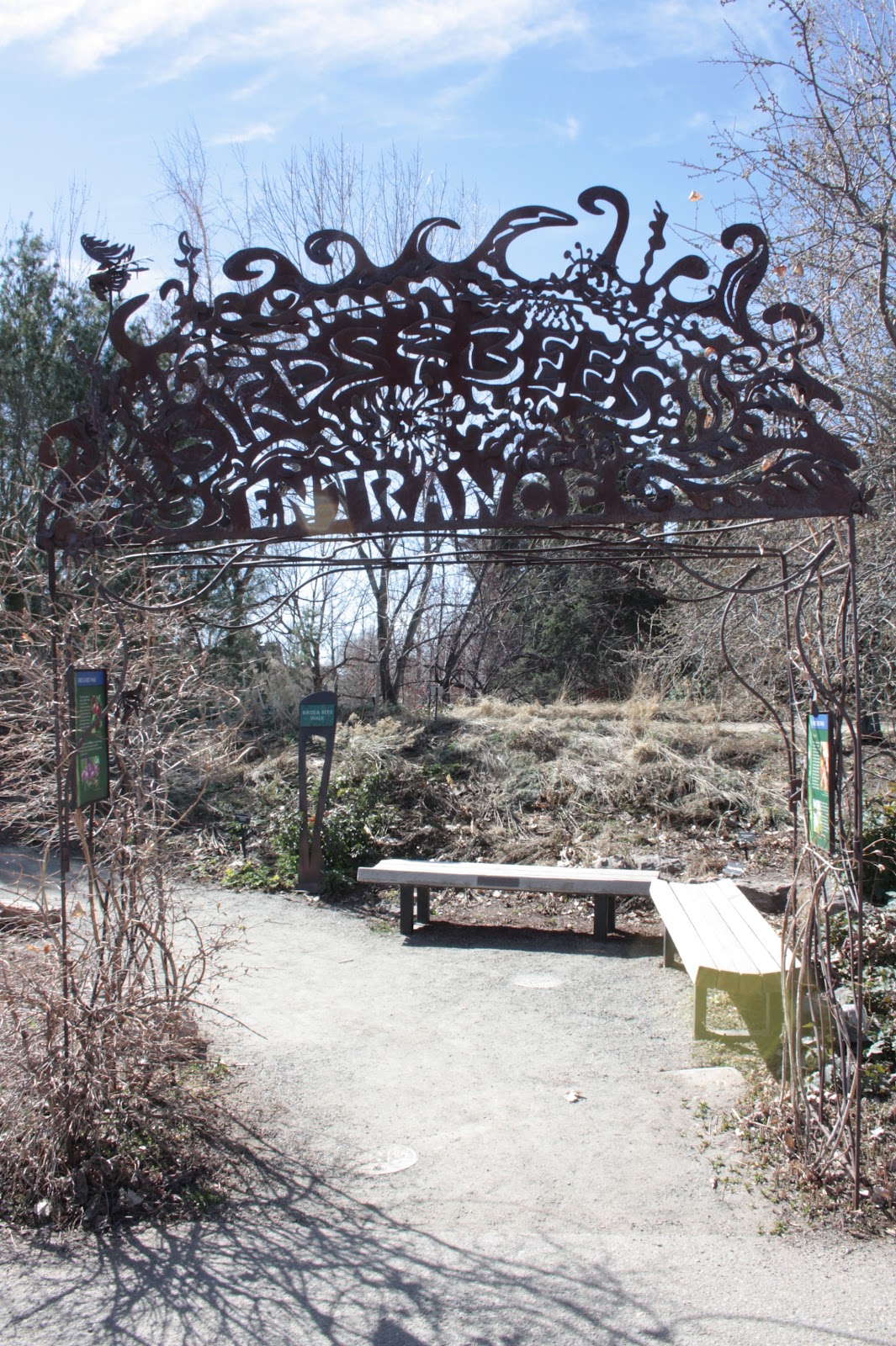
The beautifully ornate entrance to the Birds and Bees Walk - a section dedicated to flowering and fruiting plants that provide food for our feathered and winged friends.


A range of apricot trees in and around the Scripture Garden were in full blossom and contrasted wonderfully with the azure blue sky.


And on the way out, we headed one floor up above the Offshoots Cafe to see the Green Roof Garden. Developed as a visitor garden as well as an ongoing research garden, this will be studied to determine the effects of the various weather conditions of the area (hot dry summer, cold dry winter, intense radiation and parching winds).


Saturday, March 31, 2012

It's not drought, it's Denver!

I was lucky enough to be in Denver last weekend - my first time in the state of Colorado. As ever when I travel, I seek out a garden or two to visit and a quick search on Google revealed the Denver Botanic Gardens to be only a mile or two from where we were staying downtown.


I was particularly interested to see the water-smart garden within the 23 acres of planting. Denver is known as the the 'Mile High City' and the air is pretty dry at that altitude. Added to that, the location of the state within the US – it's about as central as you can get, so moisture in the air will have been shed long before any weather front reaches here. As a result, this should be the perfect place to learn about gardening with limited water.


This particular area was situated in full midday sun and filled with plants typical of dry semi-arid regions with all the adaptations you might expect to ensure the plants' survival. The sloping border is watered only seven times during the summer season and plants are grouped together according to their water requirements. Thirstier plants are positioned at the bottom of the border to maximise their use of run-off or gravitational water.

Sedums were well represented - the photo below shows Sedum 'Purple Emperor'. Thick succulent leaves allow the plant to store excess water for use later.


Lavenders and Lamb's ears (Stachys byzantia) were also included in this garden. The former has reduced leaves and the latter has fine hairs covering the leaf surface. These characteristics serve to reduce water loss by transpiration. Both plants have a silvery colouring which acts as a reflector to the strong rays of the sun.


Agave, cacti, yucca, eucalyptus, oaks and cypress line the back wall of the border and create focal points in the central areas.
The photo below shows Texas sotol (Dasylirion texanum), a relative of yucca. Its distinctive flower spike appears from May onwards and grows to an impressive 15 feet in height - and is apparently adored by hummingbirds!


Many of the smaller plants featured along the front of the border such as salvias, alliums and fine grasses are those or close relatives of those that would be easily found in UK nurseries and garden centres. Maybe, if the drought conditions continue on our side of the Atlantic, we'll be taking the lead from here and planning our own future garden plantings in terms of low water requirements and heat tolerance.

Monday, July 11, 2011

Love me tendril, love me sweet

I've recently been glued to the tv watching the ITV Botany series and am finding it absolutely fascinating. I love the history of botany and how the scientific developments and discoveries of the last few hundred years have shaped the plant and agricultural world as we know it today. I'm particularly interested in plant genetics, breeding and inheritance. They all sound so impenetrably scientific but we can all see examples in every variety of vegetable we grow.
Take, for example, this pea variety I photographed in the walled vegetable garden at the National Botanic Gardens in Dublin.


I thought it looked a bit odd, so looked up the variety - Sancho. It's a semi-leafless type, which is apparently better for commercial growers as the harvesting is easier than with leafy varieties. It seems the harvesting machinery copes better without so much foliage. So, assuming Mother Nature did not provide this Sancho variety herself, plant breeders have, over the years, selectively crossed pea varieties with smaller amounts of foliage in order to breed out the leafy tendencies. Now, on my RHS course we learnt about leaf adaptations - and a pea tendril is one such leaf adaptation. Basically it's a leaf that has adapted (in an evolutionary sense) to serve a different purpose - in this case, it helps the plant to support itself, to grow vertically, thus maximising exposure to sunlight and gaining a competitive advantage over those pea plants that cannot climb so high.
So, in the process of breeding peas to decrease the amount of leafy growth on the plant, the breeders have selected pea varieties that produce more tendrils. This has resulted in the Sancho pea that not only has less foliage and is easier to harvest for commercial and allotment growers alike, it also produces more tendrils, leading to a better in-built support system and thus a smaller need for managed support such as pea sticks, frames and nets. A most welcome development in my book.

Monday, June 20, 2011

Growing on the coast - California style

A few weeks ago, we left the suburban veg plot in the capable hands of our neighbours and headed across to the west coast of the USA. In among visiting wineries, a trip to Alcatraz and coming face to face with a rather large herd of elk in a redwood forest, we planned a trip to the Mendocino Coast Botanical Gardens. Winding our way through the extensive rhodendendron gardens (those west coast types really like their 'rhodies') we headed straight for the vegetable garden. I just love having a nosy around other people's veg gardens - usually to see what they're planting next to what or to find some new container planting idea that I can blatantly copy back in the suburban veg plot.
The organic vegetable garden at Mendocino was a beautifully laid out rectangular plot. Deep borders planted with flowers and edibles outlined the entire area and with central beds of varying sizes being cut out of the well-kept lawn. The variety of styles of veg beds was amazing - long narrow ones of rhubarb and raspberries, potager-style areas bordered with bricks, timber-sided raised beds and circular spaces for bean wigwams all overseen by a scarecrow named Dottie. My favourite idea there was a wonderfully ornate bedstead recycled as a pea frame. Definitely an idea I shall be using should the opportunity arise!


Wednesday, March 16, 2011

No queues at Kew

I took a break from the suburban veg plot last week and took the train to Kew Gardens to meet up with a good friend. The visit served a different purpose for each of us. Since completing my RHS course, I've become a little more interested in ornamental gardens and my only previous trip to Kew Gardens was as an environmental science student in the mid 1990s and I couldn't really recall much of what I saw there. She on the other hand, is a student of design and architecture and wanted to see the Xstrata Treetop Walkway designed by Marks Barfield Architects who also designed the London Eye (which, as an aside, can be seen from the walkway).
The walkway is 18m above the ground (so not for the faint-hearted) and currently accessible only by a staircase. The original lift, intended to ferry wheelchair users and child buggies to the top, hasn't worked reliably since construction was completed and is now out of service until they come up with a replacement for it. Once at the top, you have a panoramic view of Kew Gardens and the city and countryside beyond. You are quite literally walking through the treetops and I'm sure that come late spring and summer, when the leaves have returned to the trees around, the experience will be different again when you'll be able to reach out and touch the foliage.


We also took a walk around the Temperate House, once the largest glass structure in the world and now the largest surviving Victorian glasshouse in the world. It's official, I now have greenhouse envy... My greenhouse will only fit 2 grow-bags on the floor plus a small staging unit for the pots of chillies - a bit on the tiny size compared to this one...