Sunday, July 22, 2012

Rosemary beetle


Why did natural selection result in some very destructive, if very attractive insects surviving with the sole intention in life to eat my plants. In the brief respite between rain showers, I spotted these lil' critters all over my lavender bed. Oh they're very pretty – shiny like an oil droplet – but in high numbers they're not good. I've yet to discover who their natural predator is, and why those lovely colours evolve
ved to be on their wingcase. It must either be camouflage or a warning to potential predators. Anyway, despite them not being particularly welcome on my lovely flowering lavender, I don't use chemical sprays and so figured that as long as there weren't too many of them, then I could live with them. So, I took a few photos and then...how shall we put this?...streamlined the population numbers. :)


Thursday, July 19, 2012

Beanie Babies

Generally speaking, beans have not featured large in the suburban veg plot. I grow broad beans each year and I once grew runner beans (before deciding I didn't actually like them) but aside from those, my kitchen garden is a veritable dearth of beans. Until this year that is.

Through purchases and acquisitions, I found myself in possession of purple dwarf French beans, Cherokee Trail of tears climbing beans and even an ornamental purple hyacinth bean (Dolichos lablab).
Germination of them all was pretty successful in mid April – 100% in the case of the French beans – and I spent ages hardening them all off before anything left the safe confines of the greenhouse.

The gardening nerd in me loved to watch the new plant appear from between the cotyledons

The dwarf french beans were grown in toilet roll inners in a plastic fruit container. Here they are having a day out on the patio table back in May.


And once their roots started to explore beyond the cardboard tube, I temporarily potted them into a flower bucket to provide them with a bit more depth and moisture.


The french beans have been in their final positions for about 6 weeks now and have been madly producing delightfully tender beans. Their leaves are under permanent attack from our somewhat unwelcome mollusc friends but they don't touch the beans themselves, so I'm happy to maintain the standoff while that remains the case.

The Cherokee Trail of Tears beans are grown for podding beans which can then be dried and stored. They germinated quickly, grew well but then came under severe attack when I planted them out (those pesky gastropods again!). Thankfully, the brans grew slightly faster than the slugs nibbled them and they are just about hanging on. Photos to follow once I'm sure they're past the worst.

And the ornamental beans? Well, they might be a bit superfluous and don't actually contribute to the harvest, but they'll look attractive and will provide late pollen for all those lovely bees and butterflies – and I think that's reason enough. Here they are just getting to grips in their new home.


Monday, July 9, 2012

Hello - I'm back !

I have concluded that I simply cannot combine horti revision (my RHS level 3 exams) and blogging. As the queen of multi-tasking I am shamefaced to admit this. However, I have now finished my exams, have been on a little Spanish break to relax and recover and am now back and raring to go.
In the meantime, I can see by so many blogs that flowers have bloomed, strawberries have ripened, chilli flowers have opened and thousands of slugs have nibbled at your lettuces. I've been having a huge catch-up with all my favourite blogs these last few days and am almost up to date with everything that's been happening.  
I hope you can forgive my absence and I promise there'll be a bumper set of posts this month to make up for it.

Tuesday, May 15, 2012

Central Park in Spring

Today it has been rainy, then a bit sunny, then quite warm. Then back to rainy, then very very haily and back to raining once again.
So, as I can't (am too much of a fair weather gardener to) go out to take photos of my veg garden, I thought I'd reminisce about my New York trip in April and recall what beautiful sunny weather we had over Easter weekend.

Being such a gardening nerd, I eschewed long hours of shopping on 5th Avenue and dragged my mother uptown to Central Park (with promises of prosecco at the Boathouse if she was very well behaved).

I love Central Park - it's so huge you can lose yourself totally in it and the varied areas and styles of planting mean that there always something new or different to see as you progress through it. I also adore the way it is literally plonked into a grid of uber-urbanness. One minute, you're stepping out of Tiffany's (note to hubby: just browsing...) and minutes later you're tripping across Central Park South trying not to get knocked down by a horse-drawn carriage. And then immediately you're scooped up into the green lushness of the park itself.
Created in the mid 1850s in response to the green public spaces of London and Paris, the location was selected due to the natural terrain of the area (swamps and huge rocky outcrops) making urban development unfavourable. As with most large scale urban regeneration, it did involve the displacement of roughly 1600 poor residents of the area who lived in squalid shanties on the site. Some things never seem to change, do they?

If you don't know much about Central Park, this should help put it in a visual context. This photo (taken a few years ago when I took a helicopter ride over Manhattan) show the placement of the park within the city. It was in November so the trees have their autumnal colours on show.


A large rectangular shape, the park has many different areas, lots of paths and areas of water, large outcrops of stone and a variety of seats from which to take in the view.

This next one is taken from the west side of The Lake – a 20-acre man-made stretch of water – situated about a third of the way up the park. The view is looking south towards Central Park S and the towering office buildings of midtown.


This photo is taken from the same position on The Lake looking west onto Central Park West between W74th and W75th. To the left, just out of shot is the Dakota building where John Lennon and Yoko Ono lived.


There were some beautiful hellebores in flower, gently nodding in the breeze.


And can anyone tell me what these are? I really feel I recognise them but just can't come up with a name and there were no plants labels near this one...


Friday, April 27, 2012

Pea teepees

So, here we are, hurtling towards the end of April, sunglasses and factor 50 in one hand, umbrella and wellies in the other. I could take the easy route with this blog post and make some side-splitttingly ironic comment about the drought conditions and the current weather. But I won't.

Well, maybe just a little one? Just quickly?

*clears throat* "I'm glad the hosepipe ban is still on. I'd get dreadfully wet going out to water the garden otherwise" Boo, boom, tish!

Anyway, despite the monsoonal conditions of late, things are still growing in the suburban veg plot - and in the suburban veg greenhouse and the suburban veg front bedroom, aka the propagation facility.

The rain did refrain for long enough earlier in this week to allow me a quick walk around outside to review the current situation.
I have planted two varieties of peas so far - Meteor and Kelevedon Wonder. Both are reputed to cope with early sowing so hopefully they will be coping well with the return to more typical seasonal temperatures. I've come over all a bit rustic of late, so in place of a formal line of peas (that I usually struggle to suitably support, I've gone for some homegrown pea teepees. And by homegrown, I mean they've been constructed from rather large prunings from the strawberry tree and the forsythia bush. They look pretty attractive actually (she says modestly) and I've just got to hope now that the peas appreciate them enough to hang on.


Over in the greenhouse, the tomato seedlings are growing strongly and will need repotting sometime soon. I've got 3 strong seedlings of each variety: San Marzano (plum), Gartenperle (cherry) and St Pierre (salad).


The pear tree blossom is out in force on both the winter nellis and the conference pear trees. I think we've still got some cooked pear left in the freezer so I'll have to get that defrosted and cooked up in a tarte tatin to clear some space. Hopefully the wet weather won't affect the pollination of the pear trees too much. Wet weather can reduce pollination rates as, generally speaking, bees and other pollinating insects fly less when the weather is wet. Though the moment the sun comes out, I can usually spot plenty of fluffy bees hovering around the winter nellis tree.

Winter Nellis pear blossom
Conference pear blossom

The broad bean flowers are also proving popular with the local bees. And is it just me, or are they even louder than previous years? I've got 2 types of broad bean in flower - Sutton, which has a purple tinge to the outer petals (or tepals, or sepals... damn you, plant morphology module. I'm sure I was happier just thinking they were all petals) And my old reliable Claudia Aquadulce are looking as gorgeous as ever. I can almost taste my first broad bean risotto!


 What's flourishing in your garden this week?

Monday, April 16, 2012

Growing media

If you've opened a newspaper or clicked on a news website in the last few weeks you can't have failed to have fallen over an article, press release or review on the subject of gardening or gardening events. It's that time of year where the clocks go forward so we get longer days and the weather starts to warm up so everything in the garden begins to sprout forth. Much like the PR machines, marketing departments and journalists I guess.

Just a few short weeks ago was the annual press launch of the NGS's Yellow Book at the Royal Festival Hall. I was invited but, having already booked a ski holiday that spanned the launch date, could only follow on Twitter as excitable media and gardening types posted photos and comments during the canapes and drinks reception. The NGS is celebrating its 85th anniversary in 2012 which made for an extra layer of celebration. The amusing video below was made by Joe Swift, Cleve West and James Alexander-Sinclair to mark the anniversary.


Last week saw the RHS London Plant Fair open over 2 days at the RHS halls in Victoria. Daffodil, camellia, bonsai and photography competitions abound in one hall and nursery and seed suppliers trading their wares in the other. I came extremely close to buying a nectarine tree, but thankfully common sense got the better of me. A bad back, a tube and a train home are not the best companions for a 3 foot potted tree so I decided instead to make my purchase online from the comfort of a chair at home. I did stop at my favourite secondhand garden book stand and acquired a lovely book entitled: The Sun King's Garden, which I shall be putting away until my intended visit to Versailles later this year.

And finally, it's been raining all night and morning so that must mean National Gardening Week has arrived. This RHS-delivered event is designed to encourage people into gardening and to celebrate gardens and gardeners all over the UK. Events are in full swing at each of the 4 RHS gardens every day this week as well as a range of other gardens across the country - you can weave willow structures, pot up perennials, get involved in a gardening careers Q&A and join a guided tour. I, for one, will be heading to RHS Wisley later in the week to see what's going on.
In the meantime, I've decided to mark National Gardening Week by offering a 10% discount on my vintage garden items on Etsy. Click here or on the side banner and you'll find the coupon code on my Ember Gate shop front.

Sunday, April 1, 2012

Highlights of Denver Botanic Gardens

Aside from the Water Saving Garden, I discovered so many other wonderful areas and plants in Denver Botanic Gardens that I thought I'd produce a predominantly photo post to share this fabulous place with you.

Firstly, the Oak Grove, a shady area of quercus planting and woodland paths. A welcome respite from the strong sun on the day we visited.


Some familiar plants were blooming beneath the tree canopy here, emerging from the leaf litter - crocus and white squill.


The potager – a french-style vegetable and flower garden – is under redevelopment and so many of the beds were empty but the shape and flow of the beds and paths really inspired me. And I loved the central gazebo and box topiary at the corners of the beds.


Raised beds around a decked seating area were filled with spring bedding plants in full flower, all straining their heads to the sun.


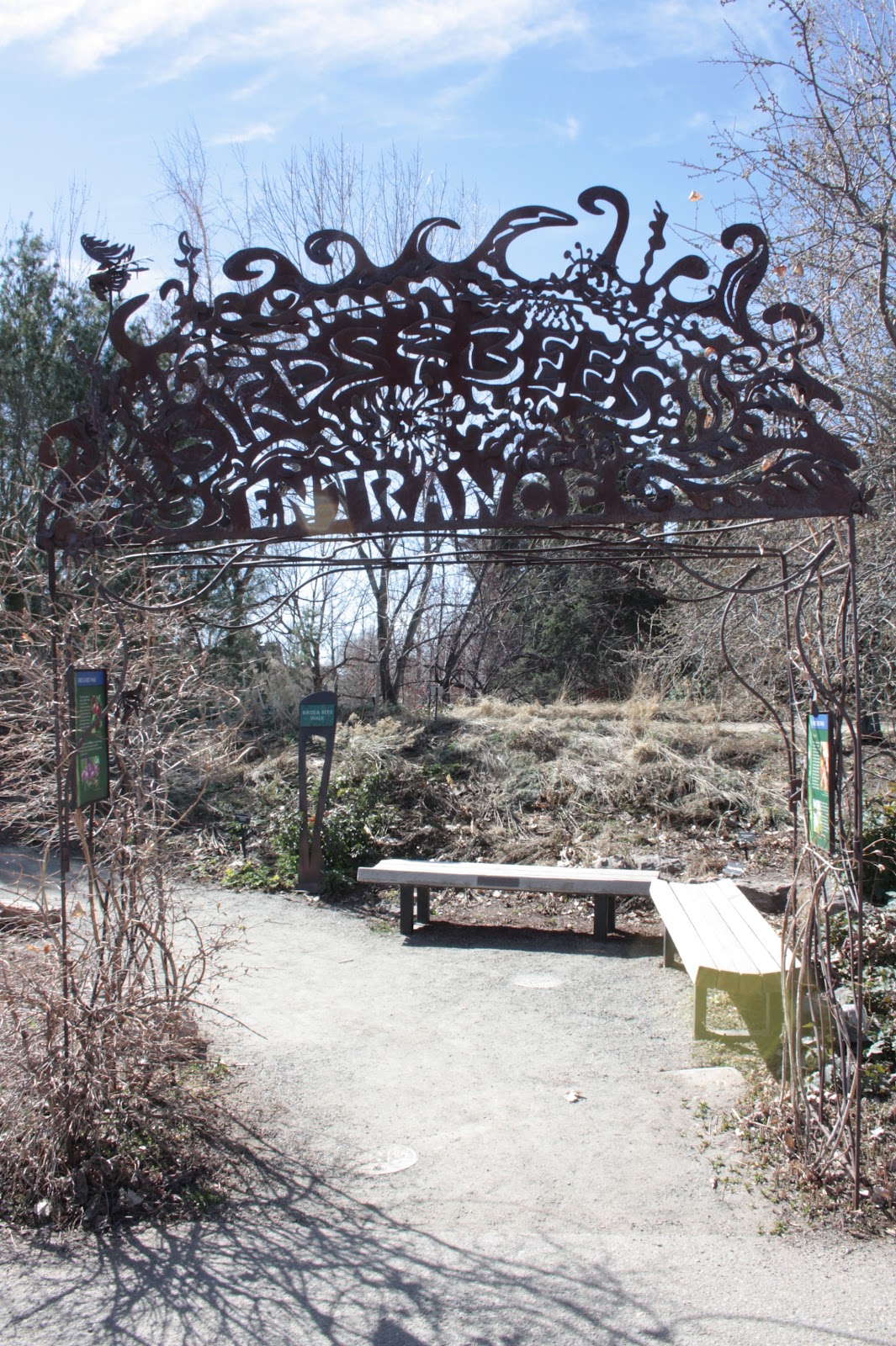
The beautifully ornate entrance to the Birds and Bees Walk - a section dedicated to flowering and fruiting plants that provide food for our feathered and winged friends.


A range of apricot trees in and around the Scripture Garden were in full blossom and contrasted wonderfully with the azure blue sky.


And on the way out, we headed one floor up above the Offshoots Cafe to see the Green Roof Garden. Developed as a visitor garden as well as an ongoing research garden, this will be studied to determine the effects of the various weather conditions of the area (hot dry summer, cold dry winter, intense radiation and parching winds).